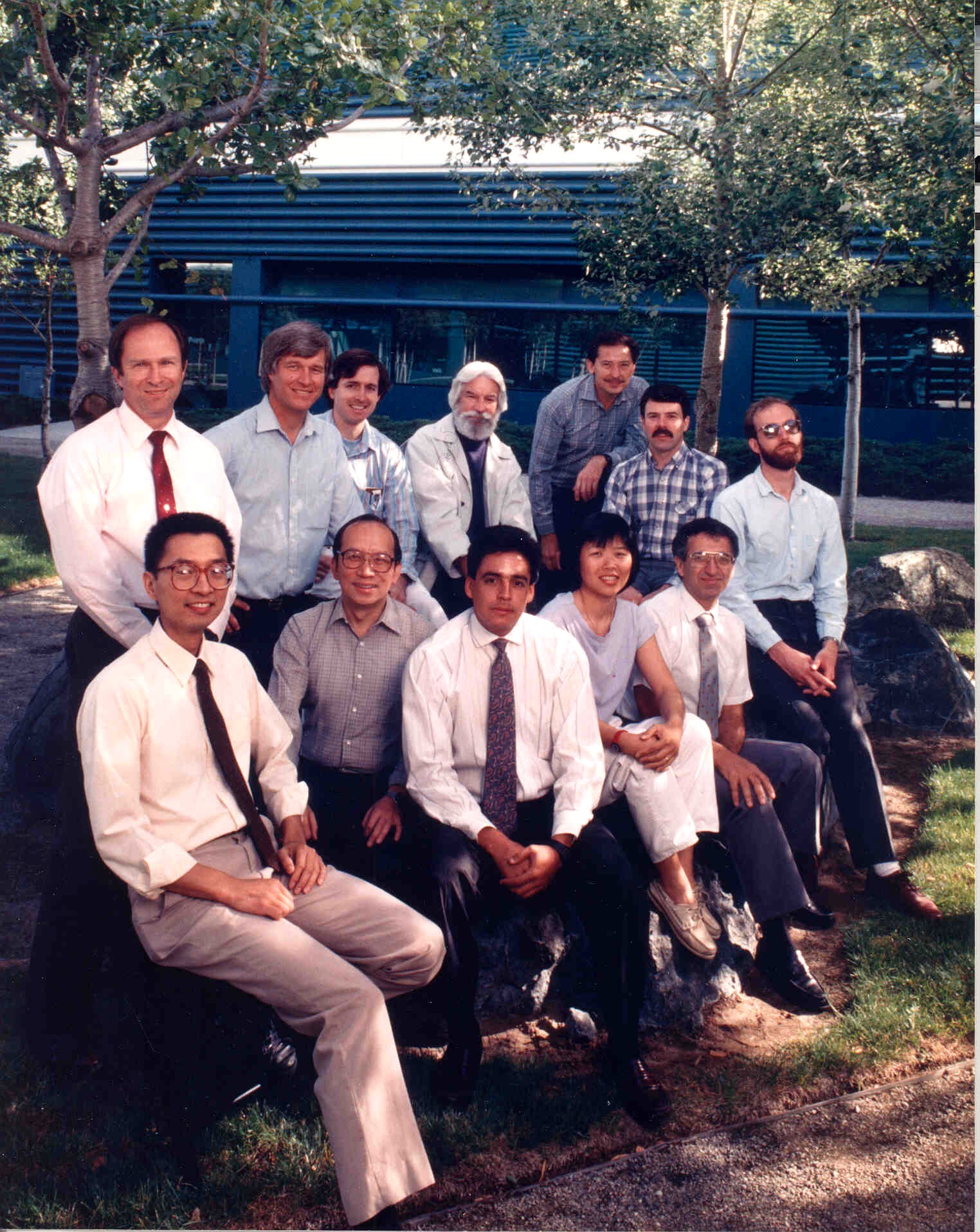
High-TC at IBM Almaden
|
|
High-TC at IBM Almaden |
|
|
Front Row (Left to Right): Victor Lee, Ting Shen, Mike Ramirez, Grace Lim, Ed Nazzal Back Row (Left to Right): Ed Engler, Jerry Torrance; Robbie Beyers, Paul Grant, Jose Vazquez, Rick Savoy, Stuart Parkin Summer, 1987 The Boys (and Girl !) of Almaden |
The complete story of the discovery of high temperature superconductivity has yet to be told. The books by Bob Hazen and Bruce Schechter cover only part of the tale. As an "insider" who participated in this exciting period, I can state that revealing someday what actually transpired between the individuals and within the institutions involved will make The Double Helix seem dull in comparison. Please return here often. My intention is to build over time my Web Site into a sourcebook on the fascinating days surrounding the discovery of high temperature superconductivity by Georg Bednorz and Alex Mueller at IBM Zuerich and the follow-on observation of superconductivity above the boiling point of liquid nitrogen in that family of compounds by Paul C. W. Chu and his colleagues in Houston and Alabama. This page will relate the events that occurred at the IBM Almaden Research Center in late February and early March, 1987. Some of the story you'll find in my 10th anniversary Nature piece, "Woodstock of Physics Revisited." |
|
Prologue -- 1986 On a January afternoon in 1986, a young scientist at the IBM Zürich Laboratory made a discovery that would change the world of science forever, a moment that might be well described by Stephen Jay Gould's term as a "punctuated equilibrium" event in the history of physics. Georg Bednorz had observed the onset of superconductivity at a temperature near 31 degrees Kelvin above absolute zero, a temperature almost one and a half times higher than previously known and in a class of materials that conventional wisdom would have said held little hope that this phenomenon would have occurred at any temperature. That evening, the young German physicist would later recall, that after many months of hard work and failure, he "really enjoyed his daily glass of beer." Twenty-two months later Bednorz, and his mentor and colleague, K. Alex Mueller, received in record time, the 1987 Nobel Prize in Physics. The news of the Zürich discovery spread slowly, and not without reason. Alex Mueller, a wizened veteran of condensed matter materials research, well knew that the history of superconductivity was replete with many instances of irreproducible "sightings," some with "transitions" well above room temperature! The two IBMers moved cautiously, submitting their findings to the German journal, Zeitschrift für Physik, one of the most prestigious scientific journals of the 20th century, a manuscript whose title contained the enticing phrase "high temperature superconductivity," and well known for its snail-like pace of publication. By the time their paper appeared that September, they had already confirmed their own discovery. But no one noticed...yet. Paul C. W. Chu, a Chinese-born American physicist on the faculty of the University of Houson, with a nose for sniffing out interesting and unusual happenings in our field, ran across the Zeitschrift für Physik publication soon after it appeared. Chu had been a student of the legendary Berndt Mathias -- who along with his long-time co-worker Theodore Geballe, together probably can lay claim to discovering more superconductors than any other researchers, past, now and maybe future -- and "inherited" his advisor's talent for "guided guessing" where new superconducting materials might likely be mined. Paul's "Edisonian" methods were controversial. However, those of us who knew him well before our collective "15 minutes of fame," often would state privately that if anyone were likely to "step in it," that is, to "intelligently stumble" on a brilliant finding, it would be Paul Chu. Thus it was not a complete surprise when rumors surfaced in late November, 1986 from Houston that in a "certain sample," a resistive drop was observed beginning at 70 K. The plot thickened throughout the next three months, and in early February Paul Chu was pictured in Time Magazine holding a small green wafer, reporting its resistance completely disappeared at 91 K. Unbelievable. The months from December, 1986, to February, 1987, were pure pandemonium. By January, the Bednorz-Mueller discovery had been well-substantiated in a number of institutions (including my own), the atomic structure of their original material established (by Bednorz), and purified to reach a transition temperature of 40 K in the compound strontium (Sr)-doped lanthanum-copper-oxide (La-214, to designate the ratio of the constituent atoms). The principal institutional players were IBM, Bell Labs, Bellcore, the US National Labs, the University of Tokyo, and, of course, Houston. Theories abounded...at least half a dozen...some of them promulgated by three past winners of the Nobel Prize...and all problematic, to say the least (there is still no universally accepted theory of "high temperature superconductivity"). This period certainly deserves its own story. And I'll get around to telling it sooner or later. Focus now turned to whatever had Paul found?...if anything! The bottom line is that by the last week of February, everyone believed him...and was frantically searching for the magic combination of elements, including Paul himself...oddly enough, even though he indeed had discovered the "holy grail," he did not yet know what it held (you can discover something, yet not really know what it's made of...the structure of DNA, a compound whose existence was known for decades, defied decoding until Watson-Crick). Paul knew it was mixture of yttrium, barium, copper and oxygen...but in what ratio and in what atomic arrangement? Most felt it was some variation on the "2-1-4" stoichiometry and structure, but they were wrong...very wrong. Fast Forward -- Early Morning Hours of 4 March 1987 It’s been 17 years, a few months and some days, as I write these words, since the breaking dawn of March 4th, 1987, when Robbie Beyers first saw, on the broken-down Stanford TEM he’d used for his PhD thesis, where the cations were and determined the unit cell symmetry and lattice parameters of Y-123. He had laboriously separated and sectioned a sub-millimeter black flake from samples we had made the previous few days before, following Paul Chu’s multi-phased recipe that appeared in Physical Review Letters on Friday, February 27th (we successfully reproduced Paul’s results late that same Friday, using dysprosium because we couldn’t find any yttrium oxide until Saturday (we had a lot of rare earth oxides around because of our magnetic storage program), and by Sunday we were making yttrium samples (Mike Ramirez called me early Saturday morning while I was trying to clear a clogged toilet in my condo...I was surprised because Mike told me he was taking his fiancé to the beach for the weekend, but had gone up to our lab instead...it's amazing what nerds will do when our life gets interesting) literally by the dozen with clean resistive transitions…but only one percent superconducting by volume!. Recall in those days, the principal phase in “Chu-stuff” was 2-1-1, whose structure Robbie also determined that morning, and was responsible for the then mysterious “green” metal appearance. The model you see me holding in the picture was built by Mike Ramirez and Jose Vazquez later that week from TEM data provided by Robbie, x-ray powder diffraction patterns from Grace Lim, and core-level spectroscopy by Rick Savoy on samples prepared by Ed Engler and Victor Lee. Superconductivity measurements on these samples, which we now dubbed "1-2-3" after the Y-Ba-Cu cation ratios, indicating superconducting volume well about 90%, were performed by Stuart Parkin, Jose Vazquez and myself. To the best of my knowledge, it is the first "PR photo" put out by IBM or anyone else revealing the structure of YBa2Cu3Oy. At the time we were unsure of the exact oxygen content. Oxygen is a peculiarly pernicious element to detect. It is practically invisible to electrons and x-rays, and core-level photoemission spectroscopy can be misleading. From simple chemical arguments, we knew "y" had to be between 6 and 9. Six was ruled out because "1-2-3" would then have been an insulator, and nine was also highly unlikely as it would have required all the copper ions to be trivalent and the structure would not have formed. Our best guess was that "y" was between 7 and 8. Robbie had observed two different crystal symmetries for "1-2-3," tetragonal and orthorhombic, depending how long the sample had been exposed to the probe electron beam in his TEM. It was almost certain this behavior was due to the ingress and egress of trace oxygen in the instrument vacuum, as the sample heated and cooled as the probe was applied and removed. If you look closely at the top plane of atom (the coppers are small and opaque, the oxygens are large and clear), you'll see the four oxygens there are "half-shaded" compared to the rest of the structure suggesting...and it turned out rightly...that it was here that the oxygen concentration, and thus superconducting properties are affected on annealing in oxygen. However, at the time, we felt the trivalent Y ion would be surrounded by its own additional set of oxygen ions to provide charge balance, and so the optimum overall oxygen concentration for the occurrence of superconductivity would be between 7.5 and 8. As the core-level spectroscopy data improved after this photo was taken, it became clear that the layer of oxygen in the yttrium plane was absent, and this range was 6.5 to 7 (presently the evidence is that the highest transition temperature in yttrium 1-2-3 occurs at 92 K when y = 6.95). Subsequently, this middle layer of oxygens were removed, and later photographs of the model (the structure, not me!), and there were many, contain this modification. Today Michael and Jose's historic ball-and-stick creation sits in my home office, destined, hopefully, to become either a family heirloom or a museum piece somewhere. Every time I gaze at it, fond memories flow back of the halcyon days of IBM Almaden in the spring of 1987 and my "band of brothers...and a sister Grace," and how we became the "mouse that roared" amongst other institutions, as first to find the atomic structure and optimal processing conditions for the original material found superconducting above the boiling point of liquid nitrogen.
|
|
|
|
|
|
|